


















The Orchestration Layer Eventually Becomes the Application Layer
Business | June 19, 2026 | By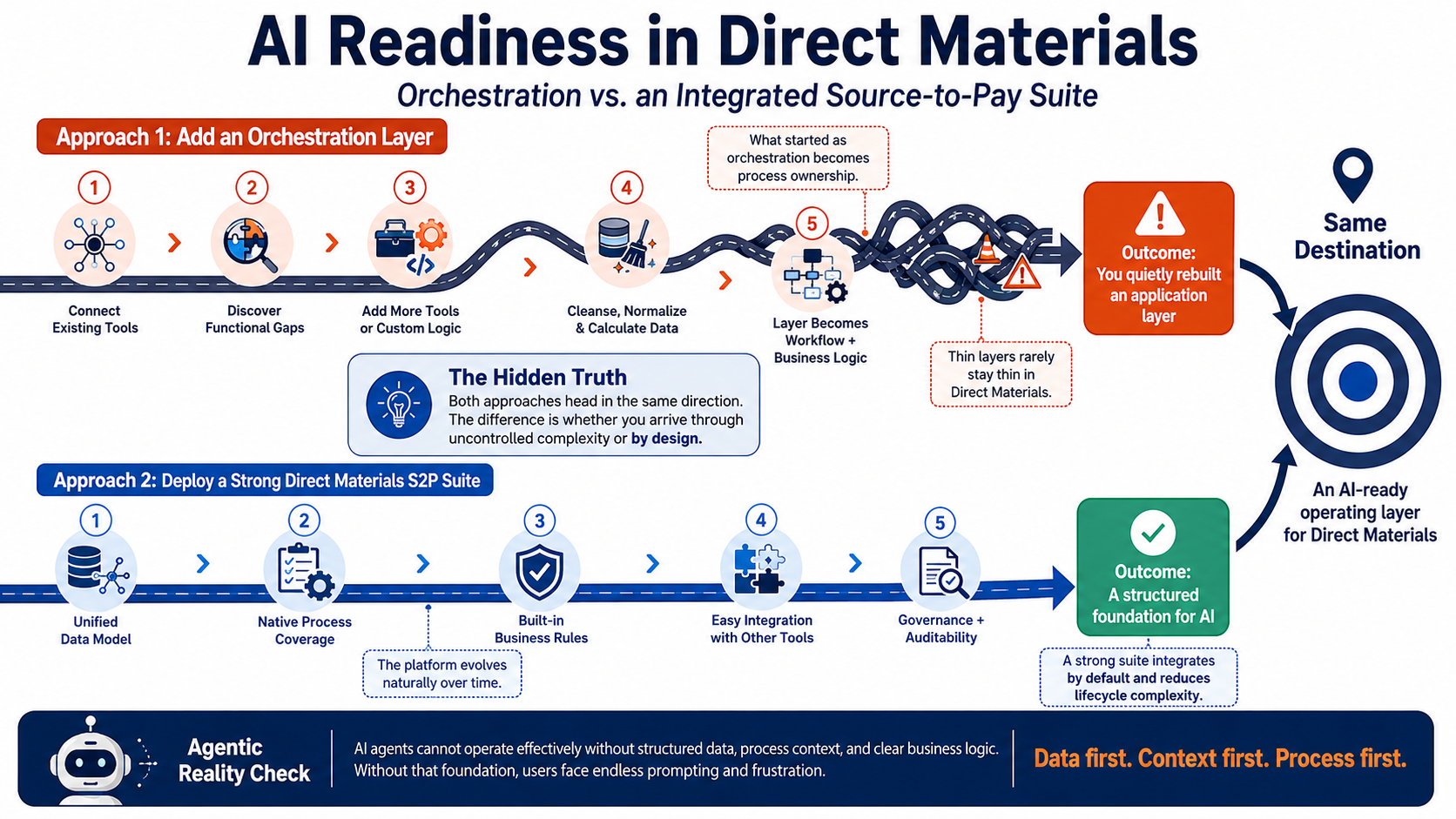
There is a growing debate in enterprise procurement technology today:
Should companies replace fragmented procurement tools with a single Source-to-Pay suite?
Or should they retain the existing toolset and place an orchestration layer on top?
On the surface, these sound like two very different approaches. One sounds like consolidation. The other sounds like flexibility. One sounds like transformation. The other sounds like pragmatism.
But in Direct Materials, the difference is not as big as it first appears.
In fact, both approaches are often headed in the same direction.
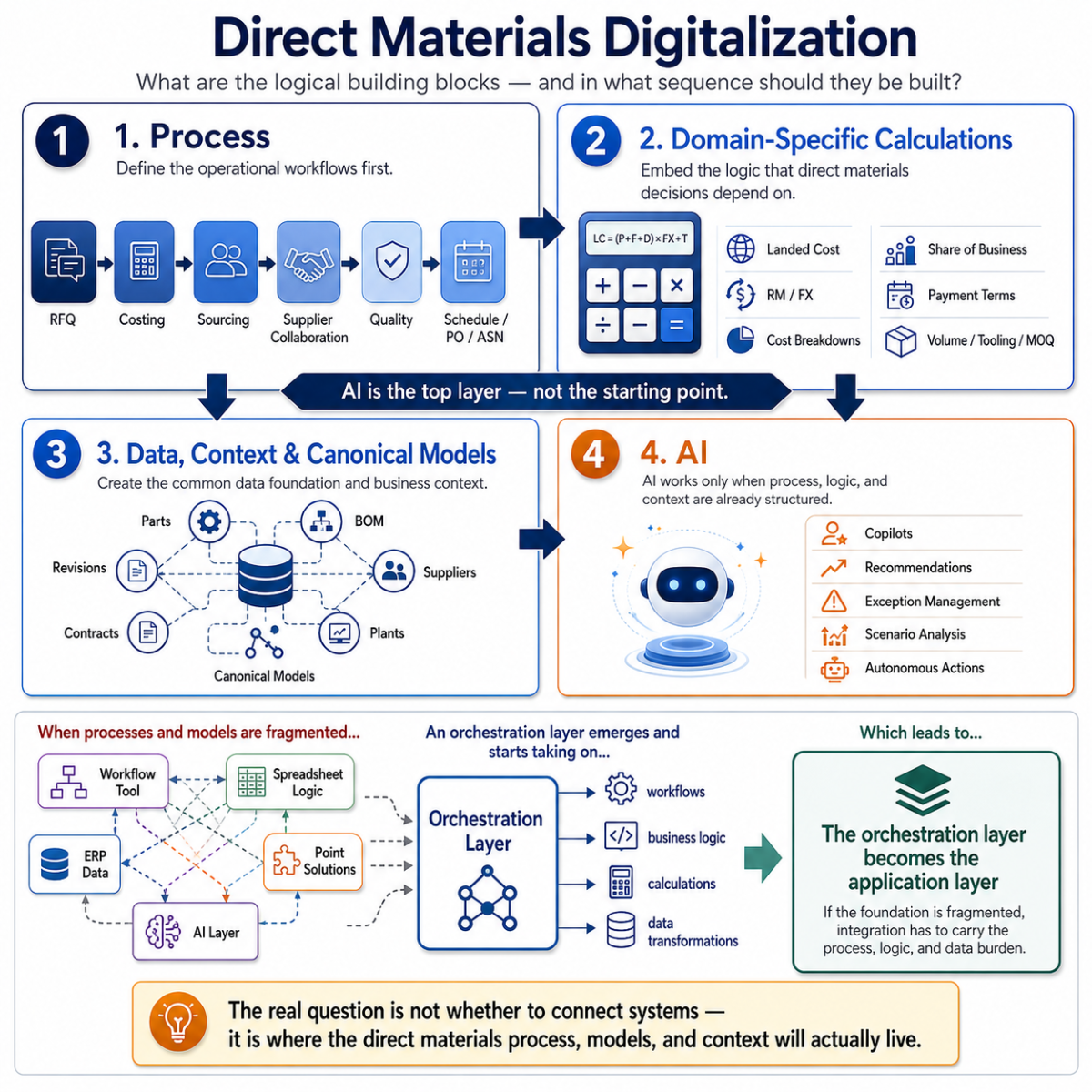
They both eventually need to solve the same problem: create a reliable, governed, process-aware, decision-ready data foundation that can support procurement, engineering, quality, supply chain, finance, suppliers — and now AI.
The real question is not whether you call it a suite or an orchestration layer.
The real question is: where will the business logic live?
Direct Materials is not a simple data movement problem
In many enterprise functions, orchestration can work reasonably well when the underlying applications are mature, standardized, and complete.
You connect system A to system B. You route approvals. You pull data from one workflow and push it into another. You simplify the user experience.
But Direct Materials is different.
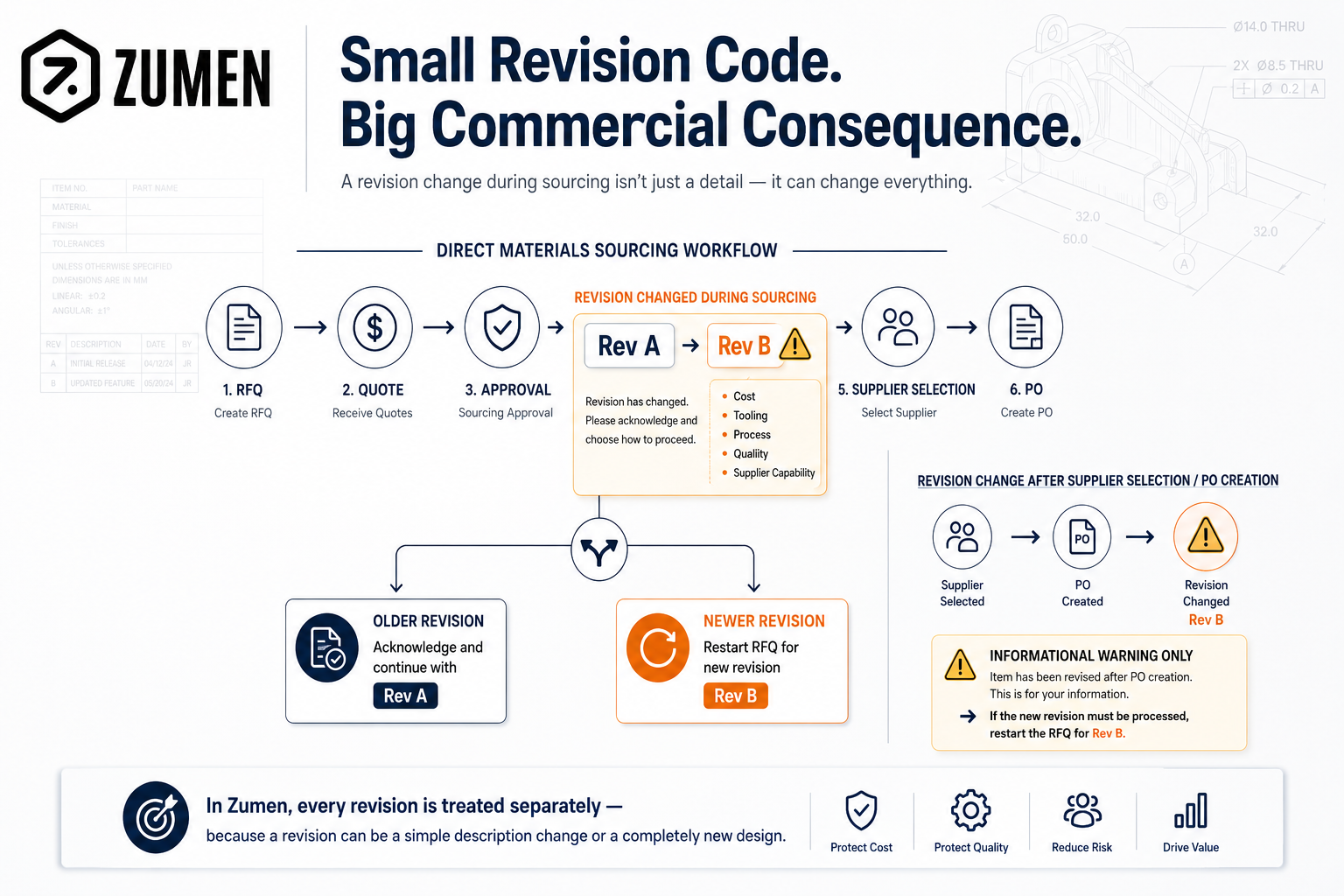
Direct Materials is deeply tied to the product itself. It is not just about buying. It is about BOMs, part numbers, supplier capabilities, tooling, quality requirements, drawings, revisions, commercial terms, raw material exposure, logistics, landed cost, production continuity, and product profitability.
A Direct Materials decision is rarely a single transaction.
It is usually a chain of decisions across multiple functions.
Engineering may define the part. Procurement may identify suppliers. Suppliers may quote with assumptions. Quality may define approval requirements. Finance may care about working capital and cost impact. Supply chain may care about capacity, lead time, and continuity. Manufacturing may care about readiness for production.
This is why Direct Materials data cannot be treated like generic procurement data.
It needs context.
And context does not come from APIs alone.
The first problem with orchestration: process gaps
When companies place an orchestration layer above their existing tools, the first discovery is usually simple:
The existing tools do not cover the full Direct Materials lifecycle.
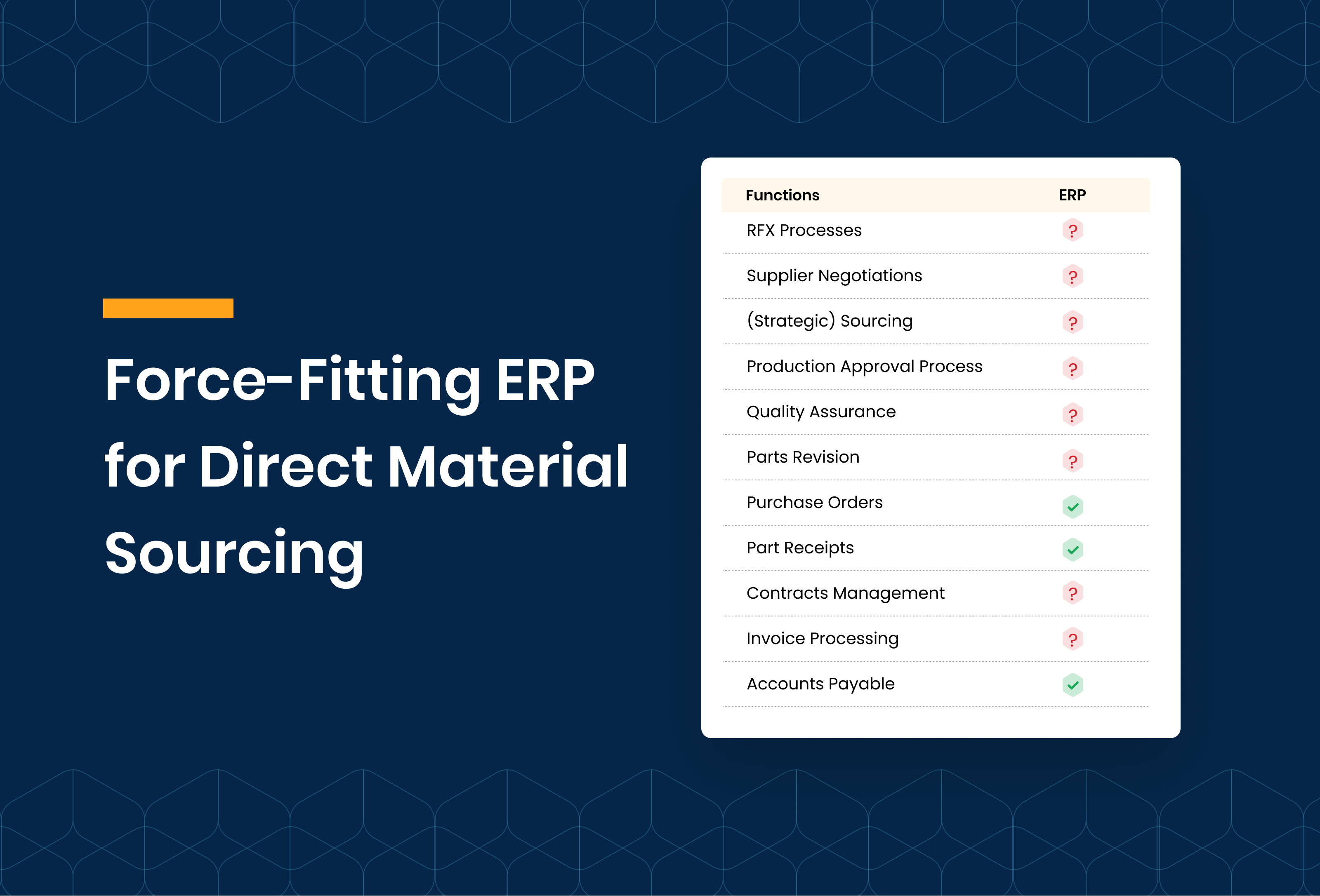
Some tools handle sourcing. Some handle contracts. Some handle supplier information. Some handle quality. Some handle ERP transactions. Some handle PLM. Some handle spreadsheets very well, because the enterprise has quietly made spreadsheets the real application layer.
Then the orchestration team asks: how do we complete the process?
There are only two options.
Either add yet another tool to close the gap.
Or build the missing logic into the orchestration layer.
If you add another tool, the system landscape becomes even more fragmented. If you build the missing logic into the orchestration layer, the orchestration layer is no longer just orchestrating.
It has started becoming an application.
It now owns data models. It owns workflows. It owns validations. It owns calculations. It owns exception handling. It owns user actions. It owns business rules.
At that point, the label may still say “orchestration,” but the substance has changed.
It has become a business application layer.
The second problem: even connected tools need processed data
Let us assume the best case.
Let us assume the enterprise already has adequate tools for sourcing, contracts, ERP, PLM, supplier management, quality, and analytics.
Even then, Direct Materials cannot run on raw handoffs.
Before one system can send useful input to another, the data often needs to be interpreted, validated, calculated, normalized, or enriched.
These are not simple integrations.
These are business computations.
And once an orchestration layer starts performing these computations, it again becomes more than orchestration.
It becomes the place where business meaning is created.
This is the central point many technology discussions miss.
In Direct Materials, data readiness is not achieved by moving data faster.
It is achieved by making the data meaningful.
Why a strong S2P suite has a lifecycle advantage
This is where a strong Source-to-Pay suite has an advantage.
Not because integration is unnecessary.
Not because every enterprise system must be replaced.
And certainly not because one application can magically solve every process problem on day one.
The advantage is that a good S2P suite starts with the right premise: procurement is not just a set of disconnected transactions. It is a lifecycle.
A strong S2P platform is designed to carry context across that lifecycle.
The supplier selected during sourcing should not become a new record during contracting. The contracted term should not become tribal knowledge during ordering. The approved price should not become a spreadsheet during cost analysis. The quality requirement should not sit outside the commercial decision. The BOM should not be separated from the sourcing event. The sourcing award should not disappear before production begins.
The value is not merely in having modules.
The value is in continuity.
And this continuity is what creates AI readiness.
AI readiness is not a technology feature
There is a lot of noise today around agentic AI in procurement.
Agents will create RFQs. Agents will negotiate. Agents will identify savings. Agents will manage suppliers. Agents will resolve exceptions.
Maybe they will.
But agents cannot operate on missing context.
They cannot confidently execute a Direct Materials workflow if the part data is incomplete, the supplier data is inconsistent, the cost logic is outside the system, the approval history is buried in emails, the quality status is unknown, and the commercial decision is sitting in a spreadsheet.
Without a strong data and process foundation, an “agentic” system becomes a polite but exhausting assistant.
It keeps asking for more prompts.
At some point, the user is not being helped by AI.
The user is training the system manually, one prompt at a time.
That is not autonomy.
That is a new user interface sitting on top of an old data problem.
Do not confuse clever interfaces with operating maturity
A conversational interface can be impressive.
A demo can look magical.
A workflow diagram can make orchestration look clean.
But Direct Materials maturity is tested in the messy middle.
These are the questions that matter.
Not whether the front end is conversational.
Not whether the architecture diagram has the word orchestration.
Not whether the sales pitch uses the latest AI vocabulary.
The practical conclusion
The market will continue to present “single suite” and “orchestration layer” as two competing philosophies.
But in Direct Materials, they eventually converge.
If orchestration remains thin, it cannot solve the real problem.
If orchestration solves the real problem, it becomes an application layer.
And once it becomes an application layer, the enterprise must ask whether it is building a shadow Source-to-Pay platform without admitting it.
This does not mean every company must rip and replace everything.
That is not practical, and it is rarely necessary.
ERP will remain. PLM will remain. Finance systems will remain. Quality systems may remain. Specialist tools may remain.
But the Direct Materials operating layer must be strong enough to hold the process together.
That is why companies should not get carried away by technology jargon.
The question is not: “Do we need a suite or an orchestration layer?”
The better question is:
“What system will become the trusted operating layer for Direct Materials decisions?”
Because that is where AI readiness will actually come from.
Not from prompts.
Not from demos.
Not from another layer of disconnected intelligence.
But from deep process coverage, clean decision context, governed data, and software built by people who understand how Direct Materials actually works in the trenches.