
















AI doesn’t fix fragmented Direct Materials digitalization. It exposes it. You need Zumen to solve the full problem.
Business | July 07, 2026 | By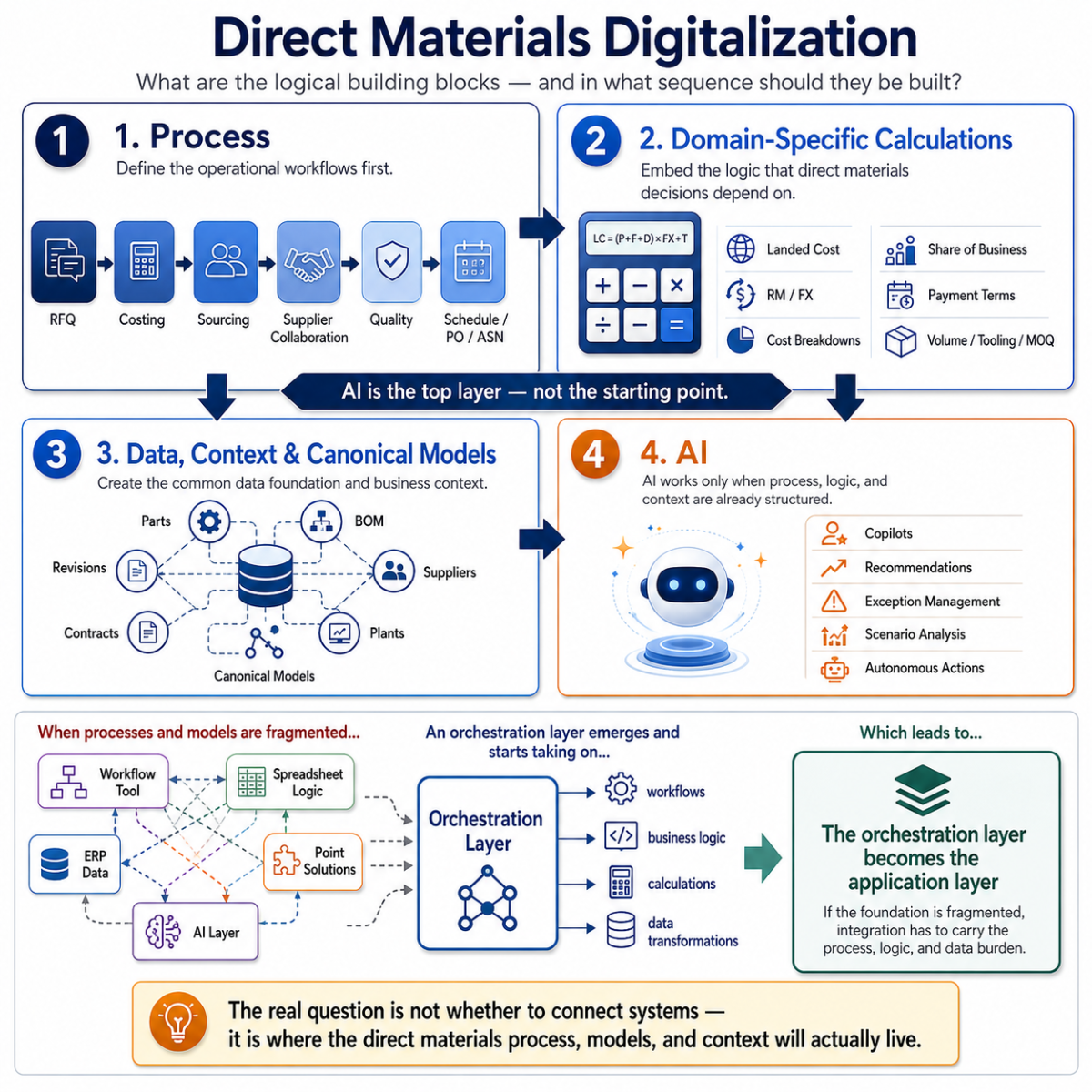
For many manufacturing companies, the conversation around digitalization has suddenly jumped to AI.
Every boardroom wants to know how AI can improve productivity, reduce costs, improve supplier decisions, predict risks, and automate work. That is understandable. AI is exciting. It is visible. It creates urgency.
But in Direct Materials, AI cannot be the starting point.
Direct Materials is not a simple procurement workflow. It is not a purchase request, approval, PO, invoice, and payment process. It is the operating backbone of a manufacturing company. It determines product cost, supplier capability, quality, delivery reliability, engineering responsiveness, profitability, and customer experience.
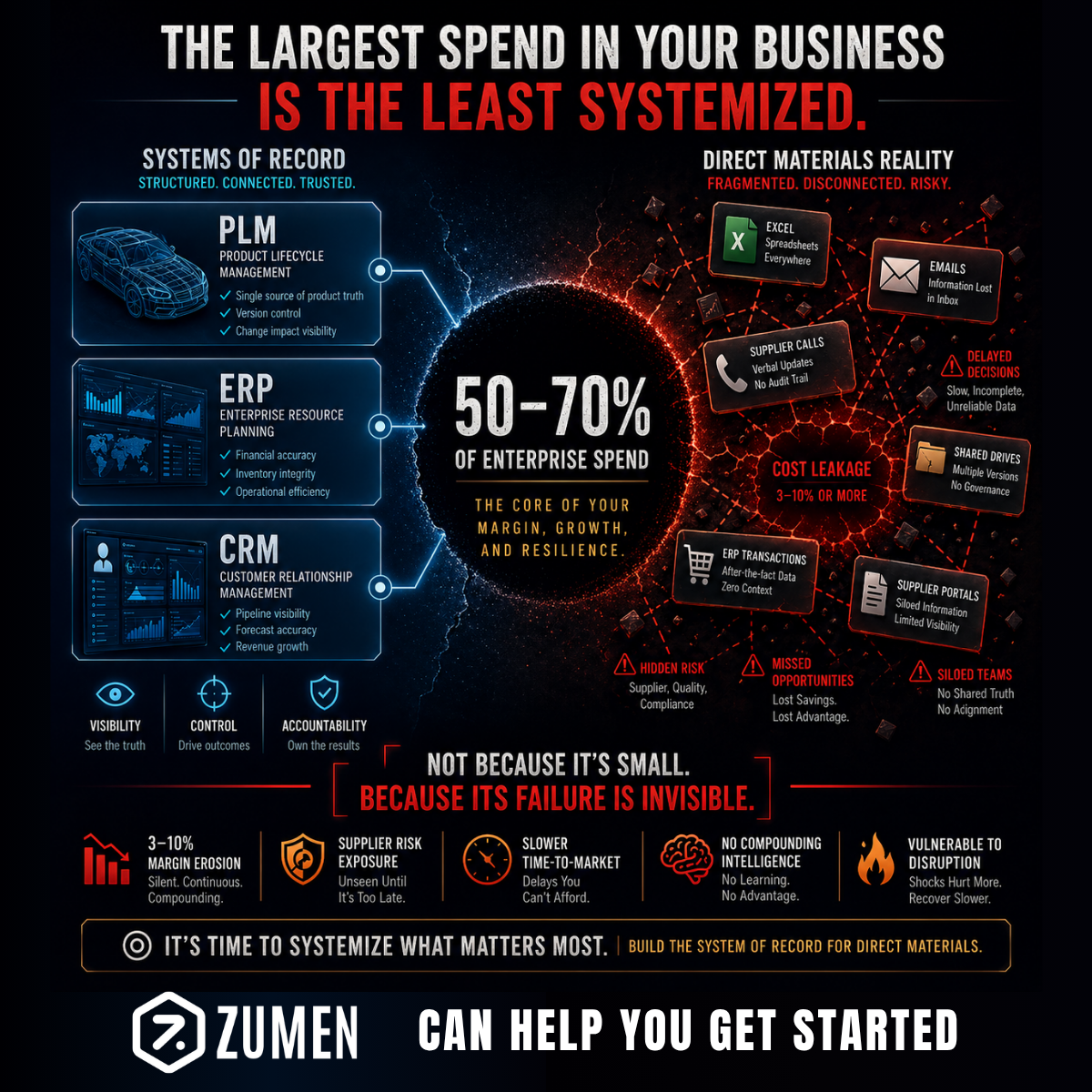
And yet, in many companies, the decisions that influence 50% to 70% of total spend are still happening across spreadsheets, emails, ERP extracts, supplier portals, shared drives, and tribal knowledge.
That is the real issue.
The question is not whether AI can be applied to Direct Materials. Of course it can.
The real question is: where will the Direct Materials process, models, calculations, data, context, and intelligence actually live?
Direct Materials digitalization has four logical building blocks
When procurement and IT teams think about Direct Materials digitalization, it helps to separate the problem into four distinct layers.
The first layer is process.
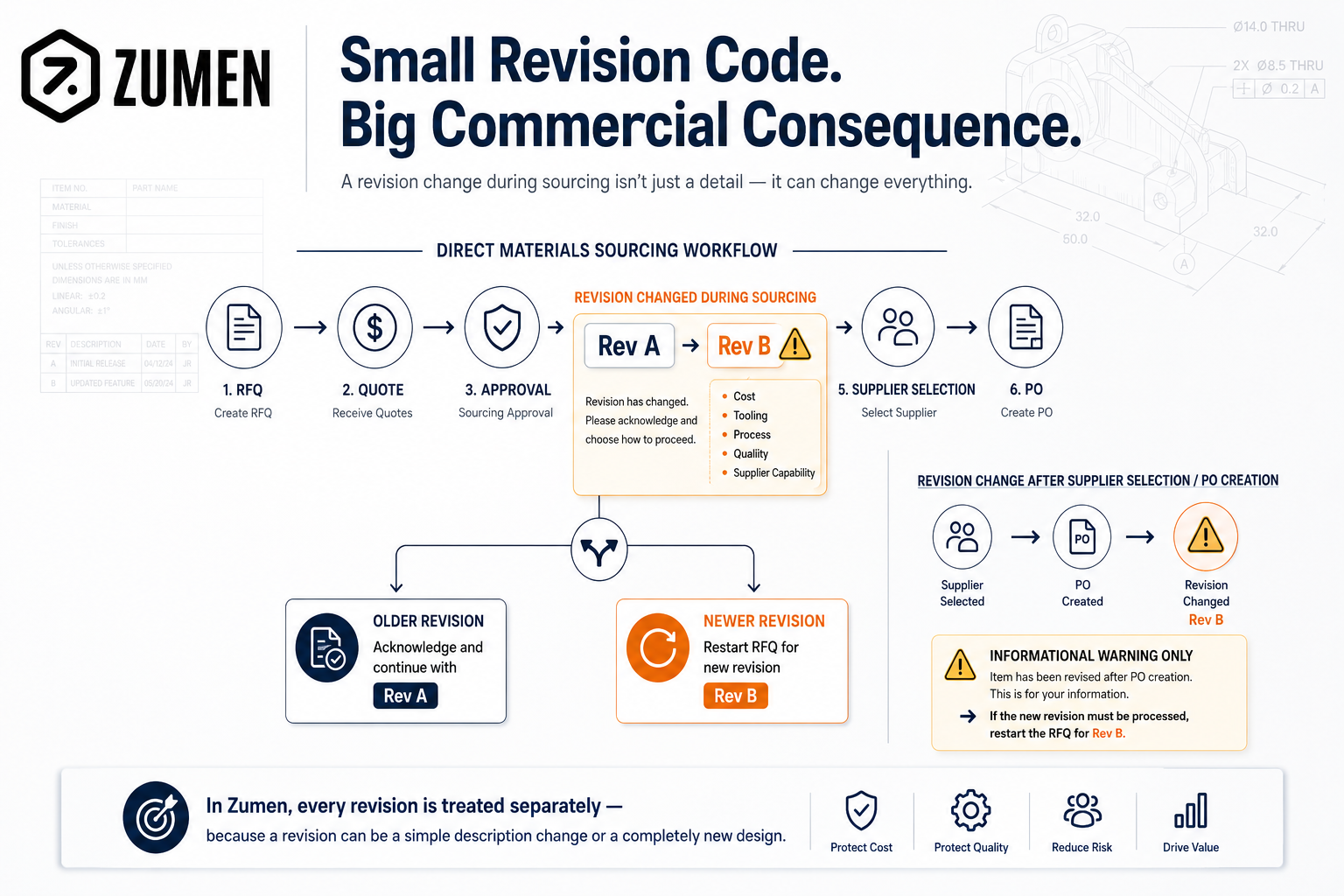
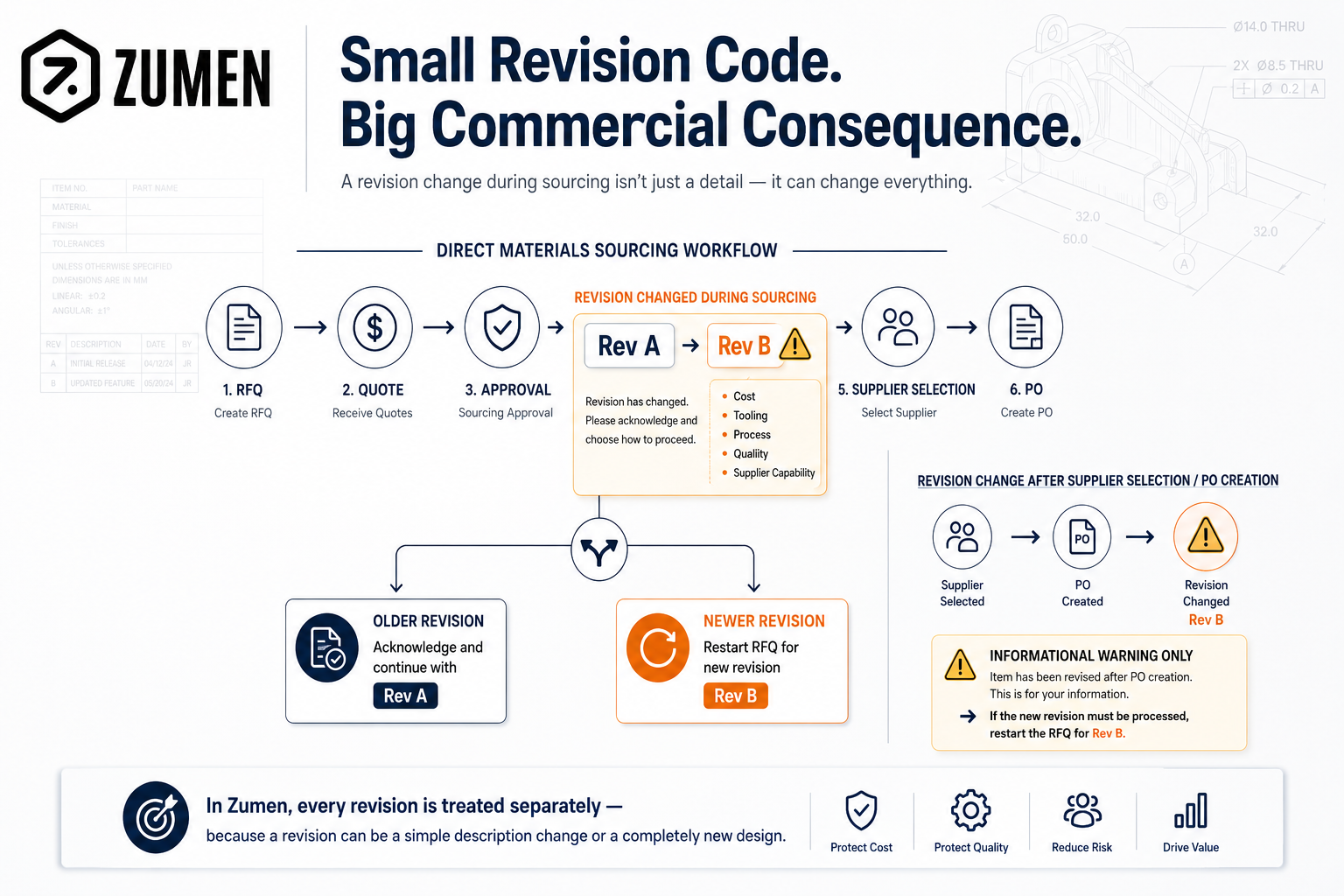
This includes RFQs, costing, sourcing, supplier collaboration, technical reviews, quality workflows, approvals, schedules, POs, ASNs, and lifecycle events such as part revisions. These are not generic workflows. They are the day-to-day operating mechanisms through which Direct Materials teams manage product-linked supplier decisions.
The second layer is domain-specific calculations.
Direct Materials decisions depend on calculations that are very specific to manufacturing. Landed cost. RM and FX impact. Cost breakdowns. Share of business. MOQ. Tooling. Payment terms. Freight. Duties. Volume assumptions. Revision impact. Effective dates. Should-cost. Target cost. Supplier price validity. These are not optional analytical add-ons. They are the logic behind commercial decisions.
The third layer is data, context, and canonical models.
A company cannot build serious digital capability if parts, BOMs, suppliers, plants, programs, drawings, contracts, revisions, cost models, and sourcing events are not connected through a common model. Direct Materials is relationship-heavy. A part belongs to a BOM. A BOM belongs to a product or program. A supplier may supply the same part across plants. A revision changes technical and commercial context. A tooling decision affects capacity and cost. A price decision affects product margin.
Without canonical models, every new use case becomes another integration project.
The fourth layer is AI.
AI should sit on top of structured process, deterministic logic, clean context, and connected models. It can help with recommendations, exception management, scenario analysis, supplier risk signals, negotiation support, cost opportunities, and autonomous actions.
But AI cannot reliably compensate for a fragmented foundation.
If the process is fragmented, AI will only see fragments.
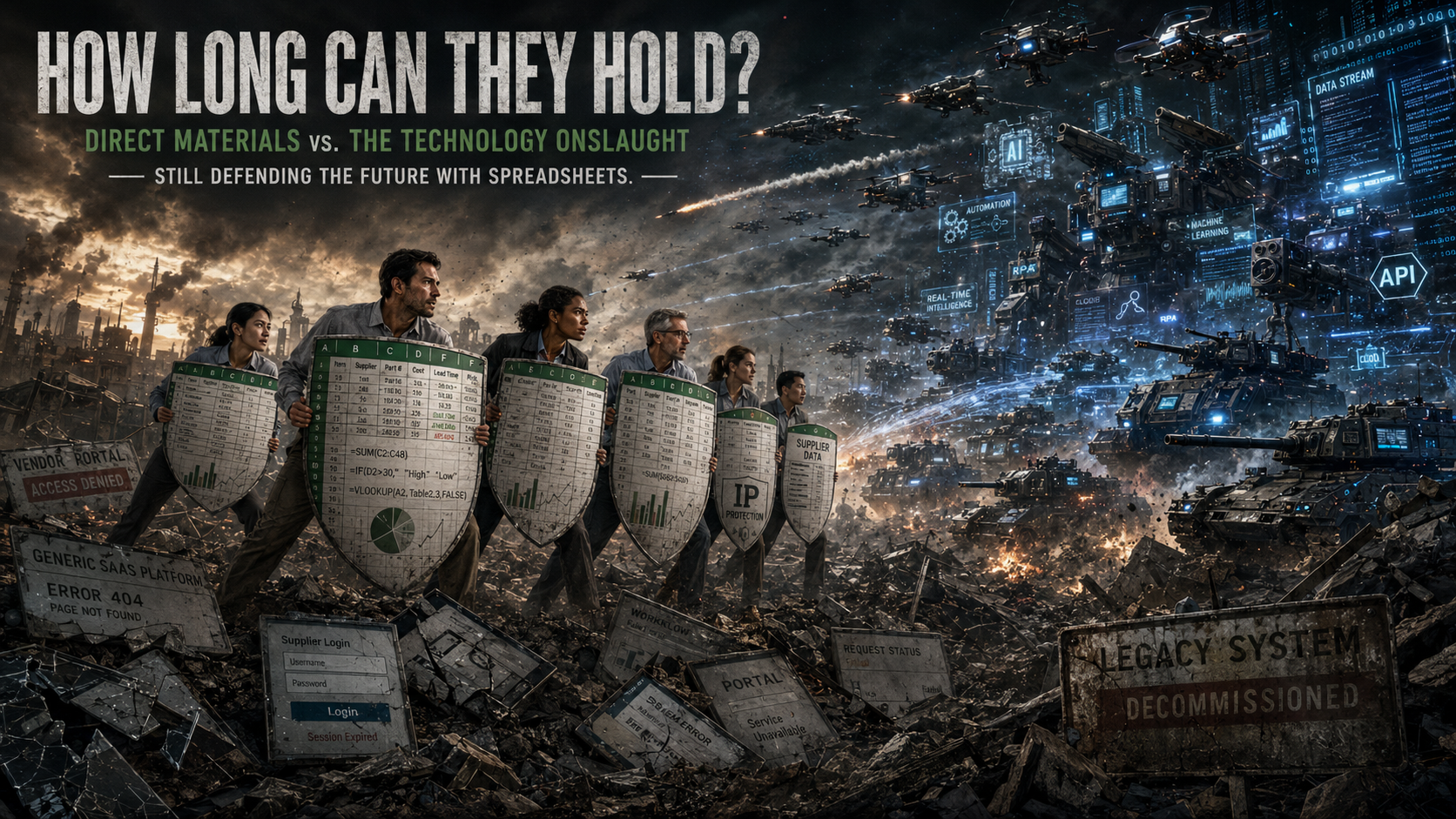
If the calculations are sitting in spreadsheets, AI will only guess around them.
If context is buried in emails, AI will summarize confusion.
If the data model is not canonical, AI will create impressive but unreliable outputs.
In Direct Materials, AI is the top layer. It is not the starting point.
Why orchestration becomes the application layer
This is where many digitalization strategies go wrong.
Companies often start with the assumption that they can keep the existing landscape as it is and simply add an orchestration layer on top. The idea sounds attractive: connect ERP, PLM, supplier portals, spreadsheets, workflow tools, analytics tools, and now AI agents.
But in Direct Materials, orchestration does not remain orchestration for long.
Why?
Because the orchestration layer slowly starts carrying workflows. Then it starts carrying business logic. Then calculations. Then data transformations. Then exception rules. Then decision context.
At that point, it is no longer just connecting systems.
It has become the application layer.
This happens because the underlying foundation is fragmented. When no single system owns the Direct Materials process, the integration layer is forced to carry the burden of process ownership. When no single platform owns the domain calculations, the orchestration layer starts becoming the place where calculations are recreated. When no single system owns the canonical model, every connection starts becoming custom logic.
This is not scalable.
It may look flexible at the beginning, but over time it creates a fragile architecture where the most critical business logic lives between systems rather than inside a system of record.
That is a dangerous place for Direct Materials decisions to live.
ERP is necessary, but it is not sufficient
ERP is critical. No serious manufacturing company can run without ERP. It is the financial and transactional backbone.
But Direct Materials decisions do not begin inside ERP.
By the time a PO reaches ERP, many important decisions have already been made. Which supplier was invited? Which supplier was technically qualified? Which revision was quoted? What cost assumptions were used? What RM index was considered? What share of business was allocated? What tooling capacity was assumed? What payment terms were negotiated? What price validity was approved? What supplier commitment was accepted?
ERP records the transaction.
But Direct Materials needs a system that manages the decisions before the transaction.
That is why trying to force-fit Direct Materials lifecycle processes into ERP often leads to heavy customization, workarounds, spreadsheets, and parallel systems. ERP was not designed to carry the complete operating context of Direct Materials sourcing, costing, quality, supplier collaboration, revision management, and commercial governance.
The same way sales leaders argued that CRM is different from ERP, procurement and supply chain leaders need to make the case that Direct Materials requires its own operating layer.
Direct Materials cannot be managed as generic procurement
A major reason this category remains under-digitized is that enterprise technology has historically treated procurement as one broad function.
But Direct Materials is fundamentally different from indirect procurement.
Indirect procurement usually deals with business spend. Direct Materials deals with the product itself.
A purchased part does not disappear after the purchase order. It continues to live inside the product. It affects cost, quality, production, supplier capacity, revisions, inventory, serviceability, and customer experience. A supplier decision made during sourcing can continue to affect the company for years.
This is why Direct Materials digitalization cannot be reduced to a generic source-to-pay implementation.
It needs to understand the lifecycle.
Part lifecycle. Product lifecycle. Supplier lifecycle. Cost lifecycle. Quality lifecycle. Tooling lifecycle. Contract lifecycle. Revision lifecycle.
When these lifecycles are not connected, the business continues to operate manually even after “digital transformation” is declared successful.
AI readiness begins long before AI
There is a lot of discussion today about AI agents and virtual employees. But in Direct Materials, decision-making has real commercial consequences.
A small change in cost assumptions can affect product profitability. A wrong revision decision can affect sourcing validity. A supplier allocation decision can affect production continuity. A payment term decision can affect working capital. A tooling decision can affect capacity. A quality decision can affect customer experience.
So AI cannot be allowed to operate on loosely connected information.
For AI to be meaningful in Direct Materials, the underlying platform must already know the business context.
It must know the part, the supplier, the BOM, the plant, the revision, the cost structure, the contract, the price validity, the approval history, the supplier capability, the quality status, the tooling relationship, and the commercial implications.
Only then can AI move from generic assistance to meaningful enterprise intelligence.
Without that foundation, AI becomes another layer of fragmented automation.
The real question for procurement and IT leaders
Procurement and IT teams need to ask a more fundamental question.
Not: “How do we connect all our existing systems?”
But: “Where should the Direct Materials operating model live?”
Where should the process live?
Where should the domain calculations live?
Where should the cost models live?
Where should the supplier context live?
Where should the BOM-to-sourcing-to-costing relationship live?
Where should revision decisions live?
Where should AI get its context from?
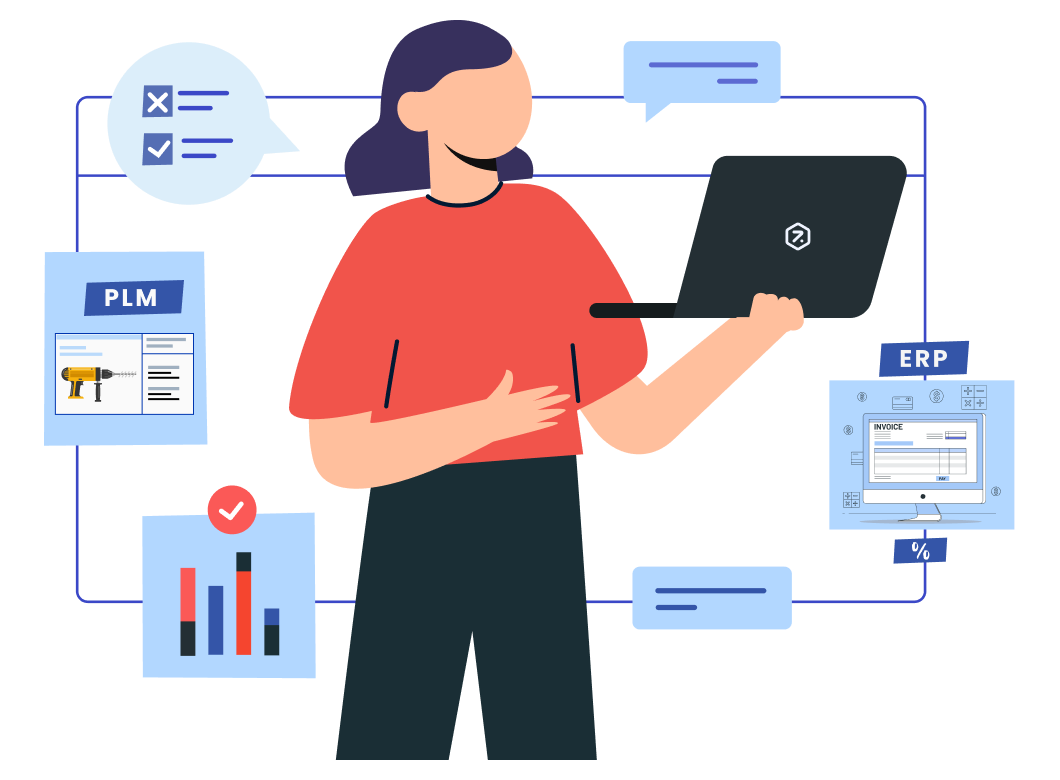
If the answer is spread across ERP, PLM, spreadsheets, emails, supplier portals, workflow tools, BI tools, and AI pilots, then the organization is not building a Direct Materials digital foundation. It is building another layer of complexity.
And sooner or later, the orchestration layer will become the application layer.
Direct Materials needs one operating layer
The future of Direct Materials digitalization will not be won by companies that connect the most tools.
It will be won by companies that build the clearest operating foundation.
A foundation where process, domain logic, calculations, data, context, and AI are built in the right sequence.
-
- First, digitize the process.
- Then, embed the domain calculations.
- Then, create the canonical models and business context.
- Then, apply AI.
That is the sequence.
Because AI does not replace the foundation. It depends on it.
For Direct Materials, the goal is not just automation. It is not just integration. It is not just analytics. It is not just AI.
The goal is to create a system of record and system of execution for one of the most important functions in manufacturing.
That is why this problem needs to be solved as a full lifecycle problem.
And that is why only Zumen solves the full problem for Direct Materials.